Lockedin App
Mobile App
Client
Blessing Adesiji - Founder, Lockedin Mindset
My Role
Product Designer
Tools
Figma Claude Notion
Timeline
2025 - Current
Description
From Feature Bloat to Focused Accountability - A Product Design Case Study
Context
Lockedin launched in October 2025 but saw 70%+ user abandonment due to feature bloat and manual logging friction. I redesigned it to focus on automatic fitness tracking and Lock Mate accountability partnerships. The streamlined prototype tested successfully, launching Q1 2026.

The Crisis: When "Do Everything"
Means "Do Nothing"
In October 2025, LockedIN launched with ambition. The vision was bold: an operating system for human performance that would help high-achievers manage deep work sessions, track fitness, block distracting apps, and build accountability partnerships. The team had poured months into building a comprehensive solution.
Within two weeks, the data told a devastating story.
The Numbers:
70%+ of users abandoned the app within the first week
Average session duration: 2.3 minutes
Feature adoption rate: Users engaged with less than 30% of available features
Database showed users accumulating massive "negative scores" - a tracking metric that incremented each day the app went unused.

The Founder's Realization:
Blessing Adesiji, LockedIN's founder, sat staring at the analytics dashboard. One user stood out: Pelumi, a paying annual subscriber who hadn't opened the app in three weeks. A quick message revealed the uncomfortable truth:
"There's too much for me to figure out in a day. I just forget that an app like Lockedin exists."
That's when I was brought in. Not to add features, but to strip them away.
Discovery: Listening to the Silence
Before touching a single pixel, we needed to understand why users were silently abandoning the app. We conducted interviews with three distinct user groups:
Group 1:
The Gym-Goers (8 interviews)
These were people already consistent with fitness - personal trainers, competitive athletes, fitness enthusiasts.
Key Quote:
I use Strava for my runs and Strong for lifting. Why would I add another app? What does LockedIN do that they don't?
Insight: They didn't understand the differentiation. LockedIN looked like "just another fitness tracker" but with more steps and less polish than established apps.
Group 2:
The Aspirational (12 interviews)
Founders, entrepreneurs, busy professionals who wanted to be consistent but struggled.
Key Quote:
I downloaded it thinking it would help me finally stick to a routine. But then I opened it and saw all these modes and timers and I just... closed it. I'll figure it out later.
Insight: Paradox of choice. The more features we offered, the more paralyzed users became. They wanted simplicity, not another project to manage.
Group 3:
The Inconsistent (15 interviews)
People with health issues, recovering from burnout, trying to rebuild their lives.
Key Quote: I felt like the app was judging me. I'd miss logging a deep work session and then feel guilty opening the app. So I just stopped.
Insight: Manual logging created guilt cycles. Missing a log felt like failure, which created avoidance, which created more guilt.
Observation:
Watching Users Struggle
We conducted 6 in-person usability sessions where users attempted to use the app while we observed silently.
Session 3 -
Michael, 34, Startup Founder:
Michael opens the app. Home screen shows four cards: "Deep Work Session", "Gym Mode", "Check-In", "Lock Mate Status".
0:15 - He taps "Deep Work Session"
0:45 - Modal appears asking "How long?" with a timer interface. He pauses.
1:20 - He sets 60 minutes, taps start
1:35 - Another modal: "Which apps should we block?"
2:10 - He stares at the list, scrolls, becomes visibly frustrated
2:40 - He closes the app entirely
"I just wanted to start working. Why is this so complicated?"

Drop-off Point Identified:
Users abandoned during setup flows that required multiple decisions before they could begin using the app.
Session 5 -
Sarah, 29, Content Creator:
Sarah opens the app at 7 PM. She worked out at 6 AM but forgot to log it.
0:05 - Sees "Waiting for Activity" status
0:20 - Realizes she forgot to start "Gym Mode" before her morning workout
0:45 - Tries to manually log workout
1:30 - Can't figure out how to backdate it
1:50 - Gives up, closes app
"If it didn't track automatically, what's the point? I'm not going to remember to press buttons every time I exercise."
Drop-off Point Identified:
Manual logging was a deal-breaker. Users wanted passive tracking, not active management.
Competitive Analysis:
Learning from the Best (and Worst)
We analyzed 12 competitors across three categories:
Competitors | What they do well | What they lack |
|---|---|---|
Fitness Trackers (Strava, Nike Run Club, Apple Fitness+) |
|
|
Productivity Apps (Forest, Freedom, Opal) |
|
|
Accountability Apps (Beeminder, Habitica, Streak) |
|
|
The Gap We Found:
Nobody combined:
Automatic tracking (fitness trackers)
Real human accountability (not vanity metrics)
Cross-domain (fitness today, deep work tomorrow)
Operating system approach (curated daily flow, not feature buffet)
The Ruthless Simplification
We created a "kill list" - features that would be removed from MVP:
Removed:
✗ Deep work sessions and timers
✗ Manual activity logging
✗ App blocking configurations (user-controlled)
✗ Custom workout plans
✗ Detailed analytics dashboards
✗ Multiple check-in points throughout day
✗ Complex onboarding questionnaires
Kept & Enhanced:
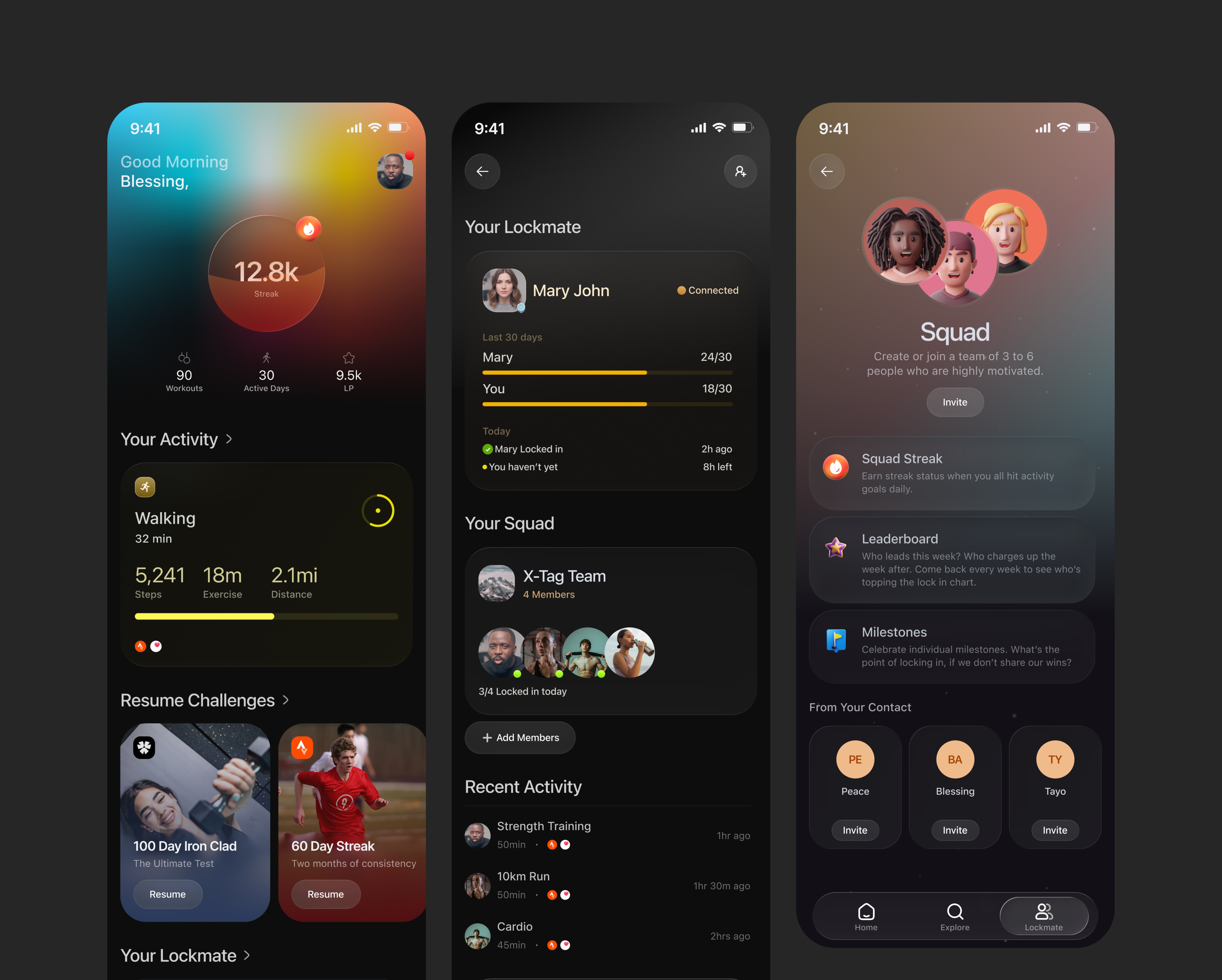
✓ Automatic HealthKit sync
✓ Lock Mate accountability (1-3 deep partnerships)
✓ Tiered movement recognition (workout/active/light)
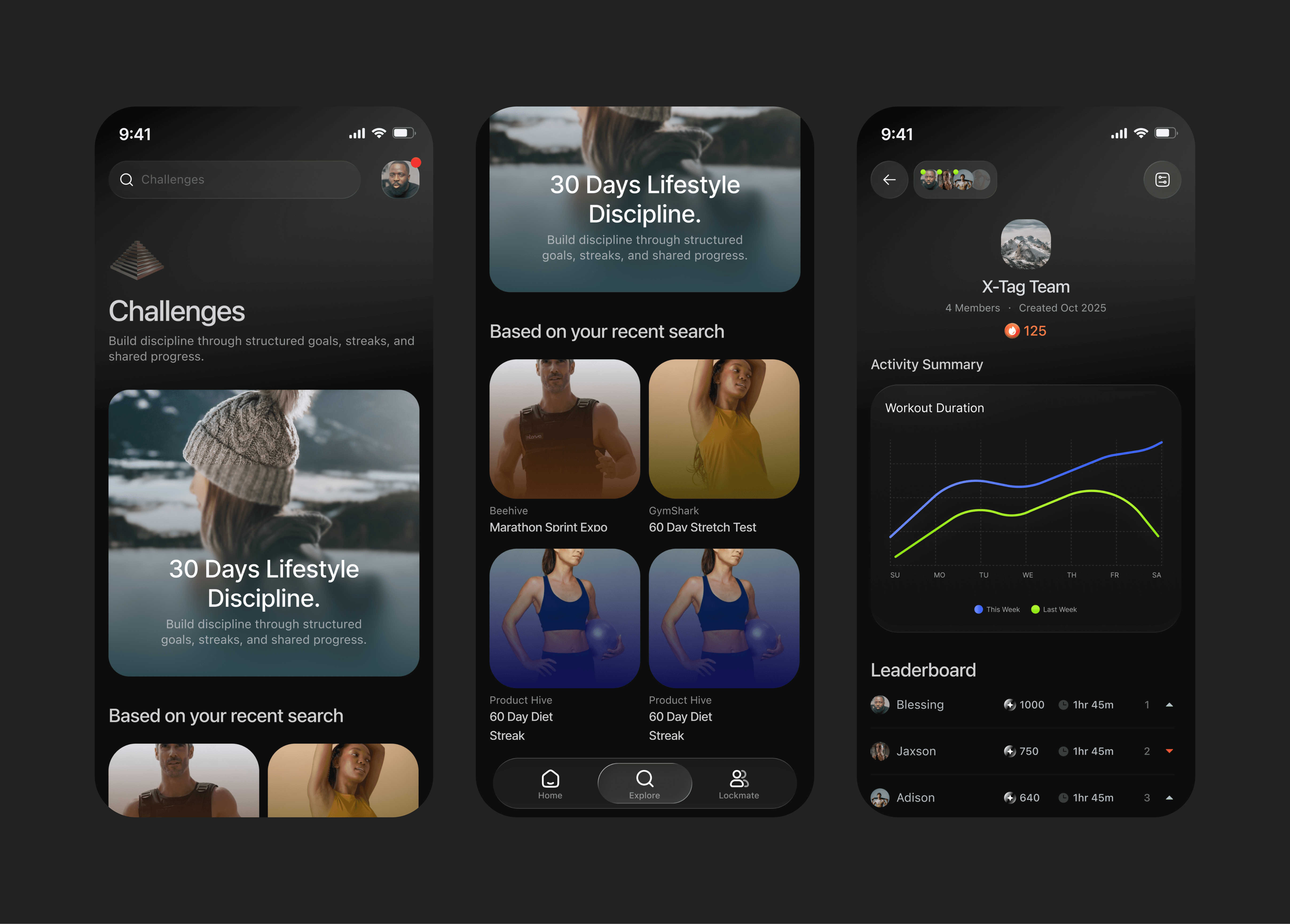
✓ Challenges with earned rewards
✓ Simple streak tracking
✓ Lock Points (LP) gamification
Added:
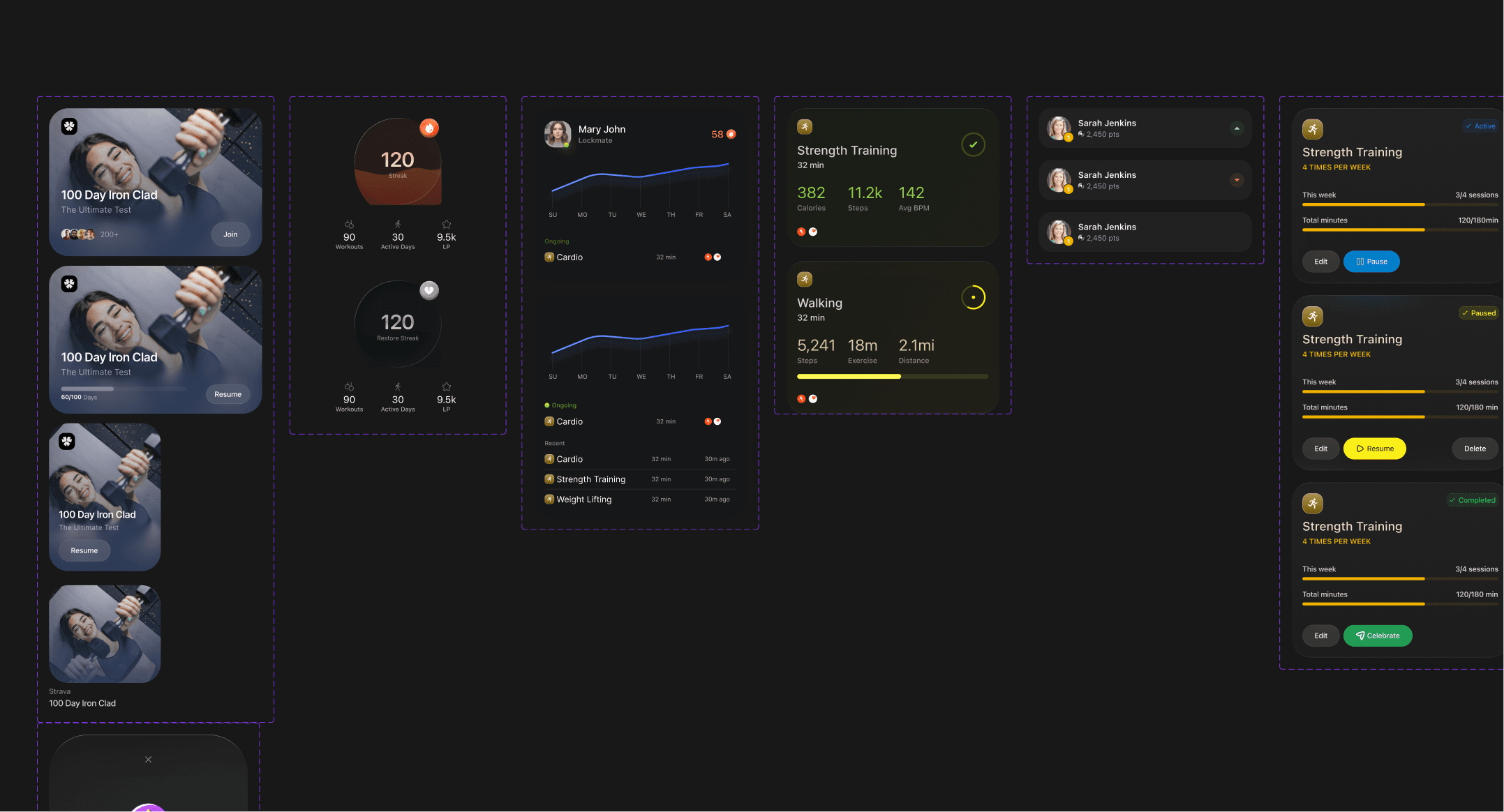
✓ Circle feature (social accountability layer)
✓ Squads (3-6 person groups)
✓ Public profiles for discovery
✓ Real-time Lock Mate status
Design Principle 1:
"The App Does the Heavy Lifting"
Old Flow:
User opens app
Decides which mode to use
Configures settings
Starts session manually
Remembers to end session
Reviews results
6 steps. 6 points of friction. 6 reasons to quit.
New Flow:
User works out (naturally, without app)
HealthKit detects it automatically
App syncs in background
User opens app later
Sees: "Workout Complete ✓ +8 points earned"
1 step…. Zero friction…. Pure feedback.
Design Decision:
Remove all manual start/stop mechanisms. The app should feel like magic, not work.
Design Principle 2:
"Someone's Watching Changes Everything"
The Lock Mate feature was always the core innovation, but it was buried in the old app.
Research Finding:
We asked 23 interview participants: "What makes you show up to the gym?"
Common answers:
"I have a gym buddy" (12 people)
"I paid for a trainer" (7 people)
"I joined a class" (4 people)
Zero people said:
Tracking apps
Fitness goals
Health metrics
Calendar reminders
The pattern: Accountability to someone else drives behavior.
The Science:
Solo accountability: 10% success rate
Partner accountability: 95% success rate
(Source cited in PRD: University research on habit formation)
Design Decision: Make Lock Mate the hero feature.


The Prototype Testing:
Week of January 13, 2026
We built a figma prototype showcasing the simplified vision. Testing with 8 users (mix of previous interviewees + new participants).
Test Protocol:
No instructions given
"Here's an app. Use it however you'd like."
10-minute sessions
Think-aloud protocol
Results:
User 1 - Jennifer, 28:
Opens app → Sees streak → Sees "Workout Complete" → Sees Lock Mate also worked out → Smiles
1:20 - "Oh, this is simple. I like that I don't have to do anything."
2:45 - Taps Lock Mate widget, explores comparison
4:10 - "I'd actually use this. It's not asking me to do work."
Success Rate: 7 of 8 users understood the app's purpose within 30 seconds (vs. 1 of 8 in previous version).
User 7 - Marcus, 35, Gym Regular:
0:45 - "Wait, so it tracks my workouts automatically?"
1:20 - "And my friend sees if I skip?"
2:00 - "That's... actually kind of genius. I'd invite my gym partner."
Design Validation: The value proposition was finally clear.
The Results (Prototype Phase)
User Testing Metrics:
Time to understand app purpose: 22 seconds (vs. 4+ minutes previously)
Completion of test scenarios: 87.5% (vs. 35% previously)
"Would you use this?" positive responses: 7/8 (vs. 2/8 previously)
Average session exploration time: 6.2 minutes (vs. 1.8 minutes previously)
What We Learned
Less is Exponentially More:
Every feature removed increased clarity exponentially. The app went from "what does this do?" to "I get it" in seconds.Passive Beats Active Every Time:
Users will not maintain manual logging. Automatic tracking is non-negotiable for retention.Real Accountability Requires Real People:
Social feeds with likes are not accountability. Someone you respect seeing your actual behavior? That's accountability.Design for the Struggle, Not the Ideal:
Users don't want apps for when they're motivated. They want apps for when they're struggling. Meeting them with Light Activity credit instead of red X's is the difference between retention and abandonment.Start Narrow, Expand Thoughtfully:
Fitness first builds the engine. The accountability system, the LP economy, the social features - these can expand to deep work, nutrition, sleep later. But master one domain first.

